Last Tuesday, at the historic Berns Hotel in central Stockholm, more than 350 executives, finance leaders, and builders gathered with a shared sense of excitement and urgency. For over a century, pivotal ideas have been debated under these chandeliers. Industrial shifts. Technological leaps. A new era beginning. This evening joined that lineage. We are not approaching a revolution, we are living through one.
The instigator? AI.
At our inaugural Best Practice in the Age of AI summit, we partnered with Legora, Strawberry, Lovable, Anthropic and JPMorgan to convene leaders navigating a shift that will define business in this century. We tackled a single question: what does best practice look like when intelligence is embedded at the core of how organizations operate?
Here's our blow-by-blow rundown of the day that was.
A new paradigm for lawyers
Legora's CEO and Co-Founder Max Junestrand set the tone for the evening with a talk (and live product demo!) grounded in day-to-day legal team work tasks. Contracts, due diligence, policy alignment: these are the parts of legal that have been manual heavy lifts for years. What's changing is not simply that review and drafting happen faster. It's that the role of the legal professional is shifting toward design and oversight. The machine handles volume. The human owns judgment.
A browser, but not as you know it
Strawberry's session, hosted by CEO and Co-Founder Charles Maddock on the day of releasing their beta AI browser, brought this to life in the context of go-to-market operations. Outbound research, CRM hygiene, contextualized messaging – tasks that once consumed mornings and evenings – now collapse into a single instruction. Freeing teams to focus on the human parts of, in this example, sales: relationship, intuition and strategic thinking.
Watch Strawberry's session on YouTube
A 500-year finance lag
Then our CEO and Co-Founder Jonathan Sanders took the stage to focus on finance. He went back to first principles: aside from some clunky software in the nineties, accounting has barely changed in 500 years, since the Medici Bank formalized double entry bookkeeping. For centuries, finance has recorded the past. With AI, the finance function becomes the architect of the future, running end to end automated finance operations, embedding real time context, accelerating the close and automating compliance without losing control.
Watch Jonathan Sanders' talk on YouTube
AI rhythms
Lovable Co-Founder Fabian Hedin's talk on building software wrapped these strands together. The ability to build internal tools, integrated workflows and context-rich databases gives organizations ownership over their own intelligence stack. When you control context, you open the door to custom, AI-native systems that reflect your business's unique rhythms.
Watch Fabian Hedin's talk on YouTube
The new cloud
Last but certainly not least, Anthropic's Head of Startup Sales EMEA Aiden Blake headed for the Berns stage to say the quiet part out loud: AI infrastructure. The key thesis being that AI models are becoming foundational utilities, much like cloud computing before them. The edge will not come from access alone, but from deep integration into proprietary data and workflows. And as capability scales, so must responsibility. Reliability, alignment and governance have to be built in from day one. Intelligence may be programmable. Trust is not.
Embedded AI
We ended the evening with a lively panel. Led by JP Morgan's Head of CIB GenAI Enablement, Allie Gillon-Livesey, the discussion underscored a healthy tension at the heart of this moment: models can execute. People still carry judgment and accountability. Speed matters, but so does governance and trust. Adoption isn't a given, even when the tools are ready.
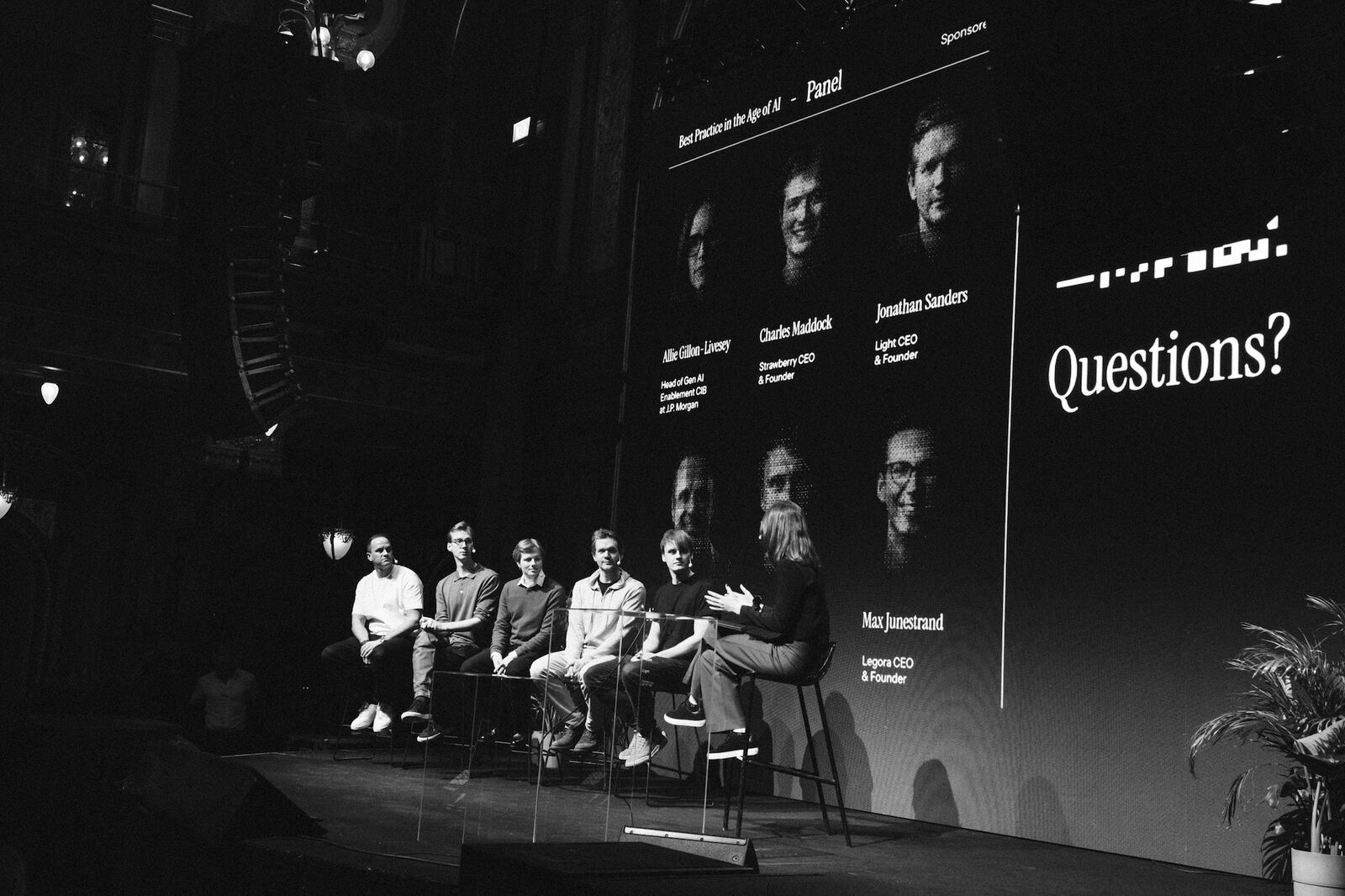
The topics were vast. Speed versus control. Centralized oversight versus team level experimentation. Competitive advantage versus regulatory exposure. What everyone could agree on was that the companies that win will not be the most cautious, nor the most reckless. They will be the ones bold enough to build AI into the fabric of their operations, not as a tool on the side, but as a capability used by every team, every day.
A new era, already underway
AI is no longer an optional layer on top of existing systems. It is becoming the substrate of how work gets done. And best practice in this age means rethinking systems, roles and organizational habits with that truth in mind.

Thank you to everyone who joined us. The discussions we started in Stockholm are just the beginning.
If you're sitting in the Finance function and keen to experience the power of AI for the first time, be sure to sign up for our Hackathons. Next up: Helsinki.