
Sometime in early 2026, quietly, software agents passed humans in tokens consumed per week. No memo went out. No org chart changed. There was no announcement, because the crossing did not happen inside any single company. It happened in the aggregate, across every business that had wired an agent into its work, and from that week on the largest consumer of intelligence at a growing number of companies stopped being their people.
Two units now denominate this economy: the token and the kilowatt hour. Intelligence is bought by the token, computation and motion by the kilowatt hour, and every serious AI company already plans in both. Only 1 of the 2 flows through a finance system. Energy belongs to the grid and the data center. Tokens run through cards, and we watch them do it: across Light customers, AI subscriptions and token spend already form the largest card spend category we process. Anthropic, OpenAI, Cursor. It grows faster than any category we have tracked, and it does not grow the way software spend used to grow, a seat at a time, renewed once a year. It grows the way usage grows: continuously, invisibly, at machine speed.
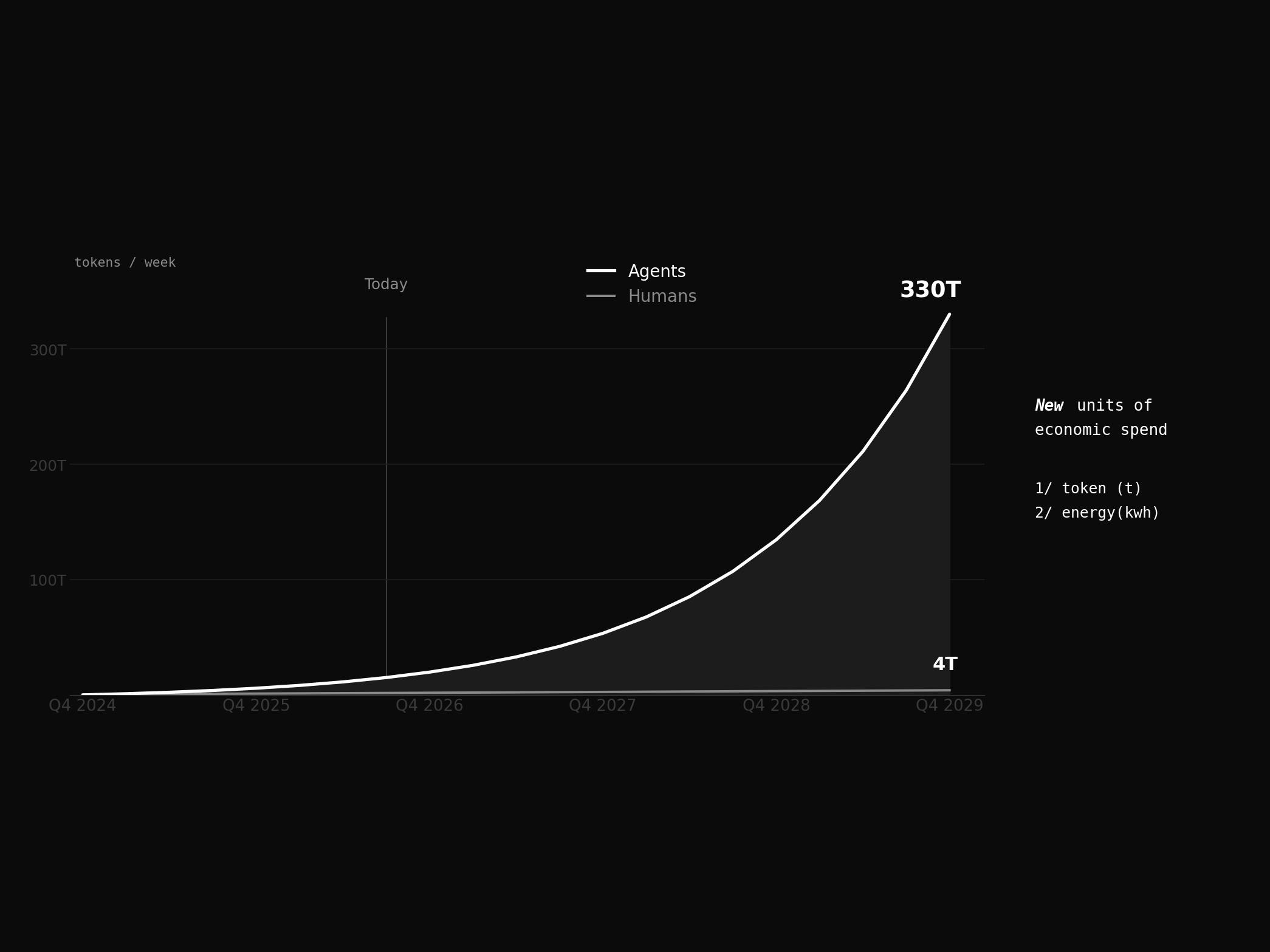
By the end of 2029, agents consume 330T tokens a week. Humans: 4T. A gap of roughly 80 to 1.
Read that chart the way a CFO reads a headcount plan, because that is what it is. Agents are headcount. Tokens are their salary. The first offer letters carrying a token budget next to base and bonus have already gone out in the US, because an employee's output now includes what their agents produce, and what their agents produce is bought in tokens. For AI-native companies the stakes are higher still: tokens are COGS. A company selling an AI product cannot price it without knowing token cost per customer, any more than a manufacturer can price a car without knowing the cost of steel.
Now hold that next to how these 2 kinds of headcount are actually managed. For human payroll, companies run the most disciplined process in all of finance: to the cent, on a schedule, with budgets, banded raises, reviews, and approvals stacked 3 deep. For the agents that now out-consume those humans, most companies run a card on file and hope. Nobody can say what a task costs in tokens, which team spent what, or whether the model doing the work is 10x more expensive than the one that could have done it. Payroll for agents means closing that gap:
- Cost per agent, per task. A piece of work has a token price. Know it the way you know a day rate.
- Allocation. Token cost lands on a team, a product, a customer, so margins stop being a guess.
- Budgets and kill switches. No agent spends in 1 night what a person spends in 1 year without something noticing and something stopping it.
- Efficiency review. Cost per outcome, benchmarked. The wrong model on the right task burns money silently, forever.
- A payroll line on the P&L. Reported like compensation, because economically that is what it is.
None of this exists in systems built for human spend. Their categories still say "software subscriptions", 1 bucket, as if an annual licence and an agent fleet drawing tokens every second were the same kind of thing. From where the chart is heading, that bucket reads like "typewriter maintenance": a label from an economy that has already ended. And the instrumentation will not arrive as another dashboard bolted on from outside, because the data needed to run it already converges in 1 place. The tokens are bought on cards, the cards feed the ledger, and the ledger is where cost meets team, product, and customer. Payroll for agents gets built into the system that already pays them.
Your agents already out-consume your people. The only open question is whether their payroll runs before or after the first bill that makes you look.