
Nobody at Light works alone anymore. Everyone works with an agent, on every part of the job: the deck, the contract, the forecast, the code.
We no longer employ people. We employ hybrids: a person and their agents, working as 1.
That changes the job of running a company. A person picks up the strategy at the all-hands, the culture from the people around them, the way of working from the desk next door. An agent picks up none of it. It starts every task knowing nothing about us, and left alone it works for a generic company.
So the crucial work is alignment. Every agent every person uses has to know the strategy, the culture and the way we work, before it does anything.
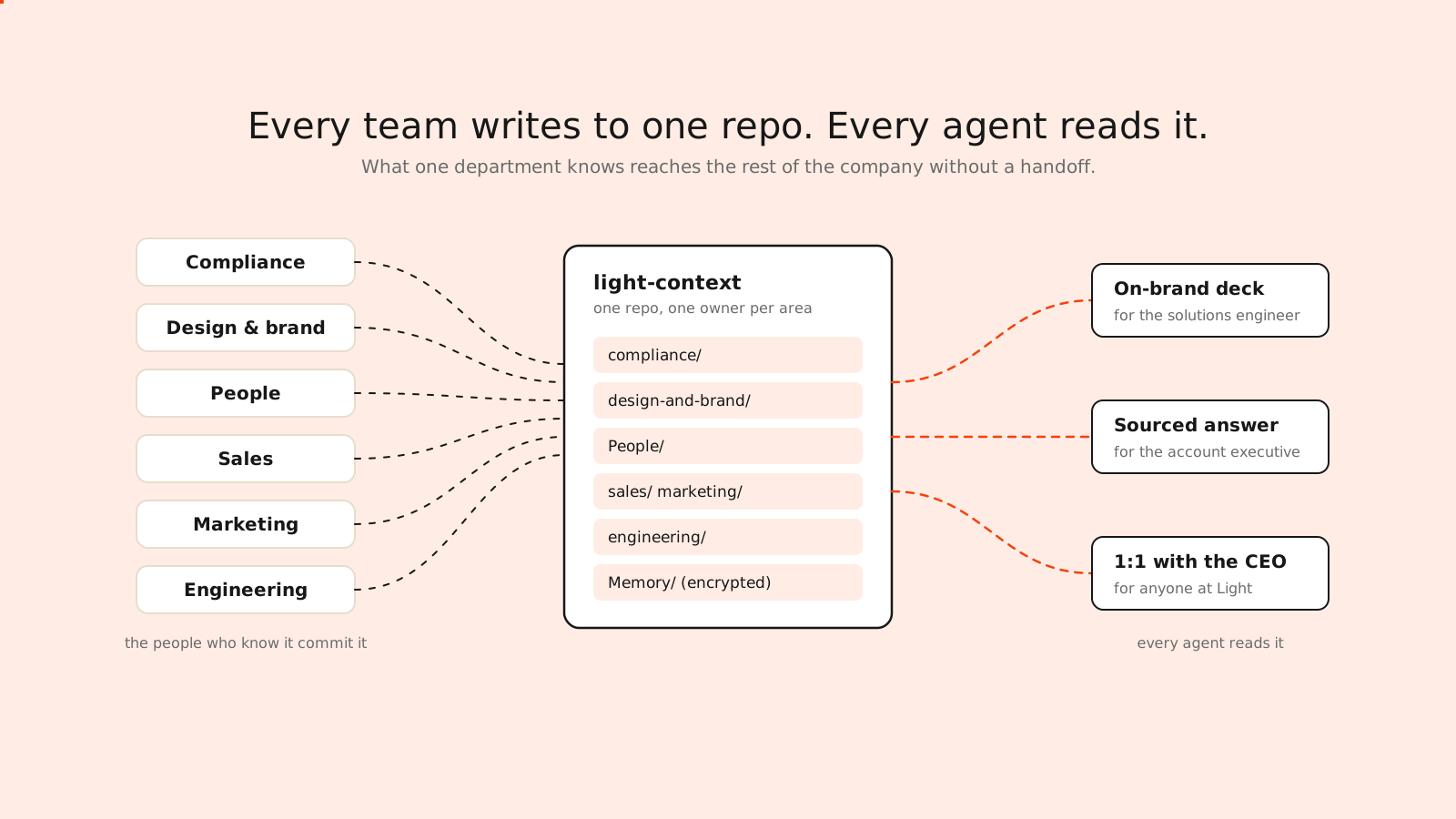
We solved it with a shared context centre. Every agent at Light reads it whenever it performs work.
This week a solutions engineer built a customer presentation with Claude. It came out on brand: the right serif, the right orange, the cream paper, the grid. It came out on message too: the right wording, and our product vision woven through it, without him setting out to put it there. Nobody from design or marketing reviewed it. Nobody needed to. Claude had read the brand rules and the vision in the context centre before it drew the first slide.
In Part I, we moved our website, API docs, help center and trust center off 4 vendors and into GitHub, so the people who knew the answer could fix the page themselves. Part II is the rest of the company, and every agent that works for it.
1 repository for everything Light knows
The context centre is a single GitHub repository. Not the code. Everything else Light knows.
Strategy, the product vision, the roadmap, the org chart, job descriptions, the performance framework, vendor agreements, contracts, the implementation playbook, brand rules. Every team has a folder: sales, design, people, engineering, marketing, support, finance, implementation. Every area has 1 named owner. Every change is a pull request.
It is written for agents first. Nobody browses it the way people used to browse a wiki. They ask Claude, and Claude opens the 3 files that answer the question.
Or they ask Sirius, our internal Slack agent, which reads the same repository. Tag Sirius in a Slack thread with a question about SOC 2 or our GTM strategy and the answer comes back in the thread, from the source. No login, no folder to find, no person to wait for.
Everyone at Light has access by default. A sync reads a Markdown table of the crew in the same repository and provisions GitHub from Google Workspace, so joining the company is joining the context.
On day 1, every new joiner runs the onboarding skill from the context centre. It sets up their AI, whichever one they use, to connect to the context centre and points their local agent instructions at it. From the first task, their agent works from the same strategy, culture and way of working as everyone else's. The context belongs to Light, not to the model, so switching from Claude to ChatGPT to Gemini is frictionless.
Commit once, read everywhere
Knowledge used to travel between departments by request. Someone asked, someone else stopped what they were doing, found the file, and sent it. Now the owner commits it once and every agent in the company can read it.
Compliance uploads its documents to the repository. When a prospect sends a security questionnaire, the account executive asks Claude, and Claude answers from the source compliance put there. Sales no longer waits on compliance. Compliance no longer answers the same question for every deal.
Brand uploads its guidelines. The brand rules, the reusable blocks, the 4 document templates. A solutions engineer asks Claude for a deck and Claude applies them automatically. The designer's taste reaches every presentation without the designer in the loop.
People keeps job descriptions as Markdown, and a workflow syncs them to our applicant tracking system. The recruiter edits the source, not the listing.
Engineering keeps its review rules and architecture there. Marketing keeps the brand spec for product videos there. Implementation keeps the playbook that takes a customer from signature to first close there. Each is a folder, an owner, and a skill that tells the agent how to use it.
A 1:1 with the entire company
I have a 1:1 with everyone at Light.
Not on my calendar. In the repository. Anyone can tell their agent to run a 1:1 with Jonathan. The skill first reads their area's roadmap and role expectations, then interviews them the way I would: what Light could become, where agents already change their work, where their area still operates as if agents did not exist, what support they are missing, what they would change if they owned the outcome end to end. It closes with 1 action for them and 1 for me.
The employee reads the notes and approves them. Then they are encrypted for 2 people: them and me. The repository sees a filename. Only we can read the conversation.
I read them, add follow-up questions, and push. They answer when they are ready.
Private 1:1s with the CEO are already on record, each approved by the employee before it was saved.
A CEO used to hear from the company through its managers, 1 layer at a time. Now I hear from the company directly, in its own words, on its own schedule.
Every company has tried to coordinate what it knows. Notion, SharePoint, Google Docs. From here they look like filing cabinets: places knowledge went to be kept, not used. The folder nobody owned. The deck with 6 versions. The Slack thread asking who has the latest SOC report. Finding the current version always meant asking a person.
At Light, agents make sure new knowledge arrives the right way. Obsolete knowledge is archived. New knowledge overwrites it. Retrieving it is seamless.
Martin writes a document on demand gen strategy. Luke deletes it and folds it into a wider marketing plan. Later, Martin asks his agent what happened to his document. The agent answers who removed it, when, and why, because every change records a reason. In Google Drive, Notion or SharePoint, that answer does not exist.
In the repository, knowledge has an owner, a history and an audit trail. It can be reviewed, reverted and permissioned. Private things stay private because they are encrypted, not because they are hard to find.
And it is read. Every day, by every agent, on behalf of every person at Light.
There is an old saying about companies where the left hand does not know what the right hand is doing. Every company now has that problem inside every seat. The right hand sits in the meetings and listens to the all-hands. The left hand works from Anthropic's or OpenAI's system prompt and has heard none of it. The context centre is how, at Light, the left hand knows what the right hand is doing.
What does your left hand do?