A polished chat demo tells you little about how a system will handle your next close. The questions get more useful when you bring an awkward invoice, an intercompany transaction or a correction to a posted entry.
Use those cases to compare AI accounting software. Establish the accounting coverage your business needs first, then test how the AI helps people complete that work and inspect the result.
This is Light's editorial shortlist, based on public product information checked on 28 September 2026, with the Light and Rillet platform comparison refreshed on 6 October 2026. The fit assessments below are our judgement, rather than an independent ranking or a hands-on benchmark.
How should you compare AI accounting software?
Agree the buying criteria before the demos. Use the same invoices, bank transactions and reporting questions with each vendor. Ask what the AI can read, propose, approve and post, then inspect the evidence behind an action.
Also test a correction and a missing document. You need to know what happens when the system lacks enough information, how a person intervenes and whether a repeat run duplicates work. The AI agents for finance guide provides a more detailed control checklist.
What should an AI accounting demonstration prove?
Use one supplier invoice and one deliberate exception across the shortlist. This is an evaluation scenario with invented amounts, not a measured result from any product. Assume your policy requires a different person to approve a €12,000 annual software bill and finance has approved spreading the cost over twelve equal months, excluding tax.
| Test | Evidence to inspect |
|---|---|
| Prepare the bill | Supplier, entity, service dates, coding proposal and original document |
| Apply the policy | €1,000 monthly expense, the remaining prepaid balance and the reviewer responsible for the treatment |
| Change the supplier's bank details | An independent verification step before payment, with the changed details visible to the reviewer |
| Try an unauthorised action | A refusal or escalation, with a record of the attempted action |
| Correct and retry | The original record, the correction and a check that the retry has not created a duplicate |
The finance team should be able to explain what the assistant proposed, what a person approved and what actually posted. Record missing evidence as a gap, including for Light. The internal controls example provides the review sequence; Light's workflow documentation explains the configuration to inspect in a Light demonstration.
Which products belong on the shortlist?
| Product | Best for this buying situation | Main evaluation question |
|---|---|---|
| Light | A finance team seeking a full finance platform, including built-in spend management | Which separate systems can you retire, and which existing tools should stay connected? |
| Rillet | A team seeking AI accounting and revenue workflows connected to its wider finance tools | How will the ledger work with your spend and AP providers? |
| Sage Intacct | A finance team prioritising multi-entity financial management | Which capabilities and integrations does the proposed scope include? |
| Xero | A smaller business reviewing automation within its current accounting setup | Does the setup still fit your reporting and entity needs? |
Platform scope matters as much as the ledger. Light brings accounting and operational finance into one platform, including cards, expenses and spend management. Rillet's published approach connects its accounting platform to specialist spend and AP tools. Compare the complete proposed setup, including any separate subscriptions, integrations and administration. Sage Intacct offers an established financial management option, while Xero gives smaller businesses a reason to inspect what their existing platform can do before migrating.
Light
Best for: finance teams seeking a full finance platform for the ledger, payables, receivables, cards, expenses, spend management and group reporting.
Light includes spend management within the platform, so a separate spend tool is not a prerequisite for those workflows. This makes it possible to replace point solutions as well as the accounting system.
You can also start with Light as your ERP and retain existing tools where that suits the business. Agree which systems to keep, replace or connect during scoping, and verify the required integrations. For example, you can bring existing company cards into Light, with transactions imported by CSV or API, without reissuing the cards.
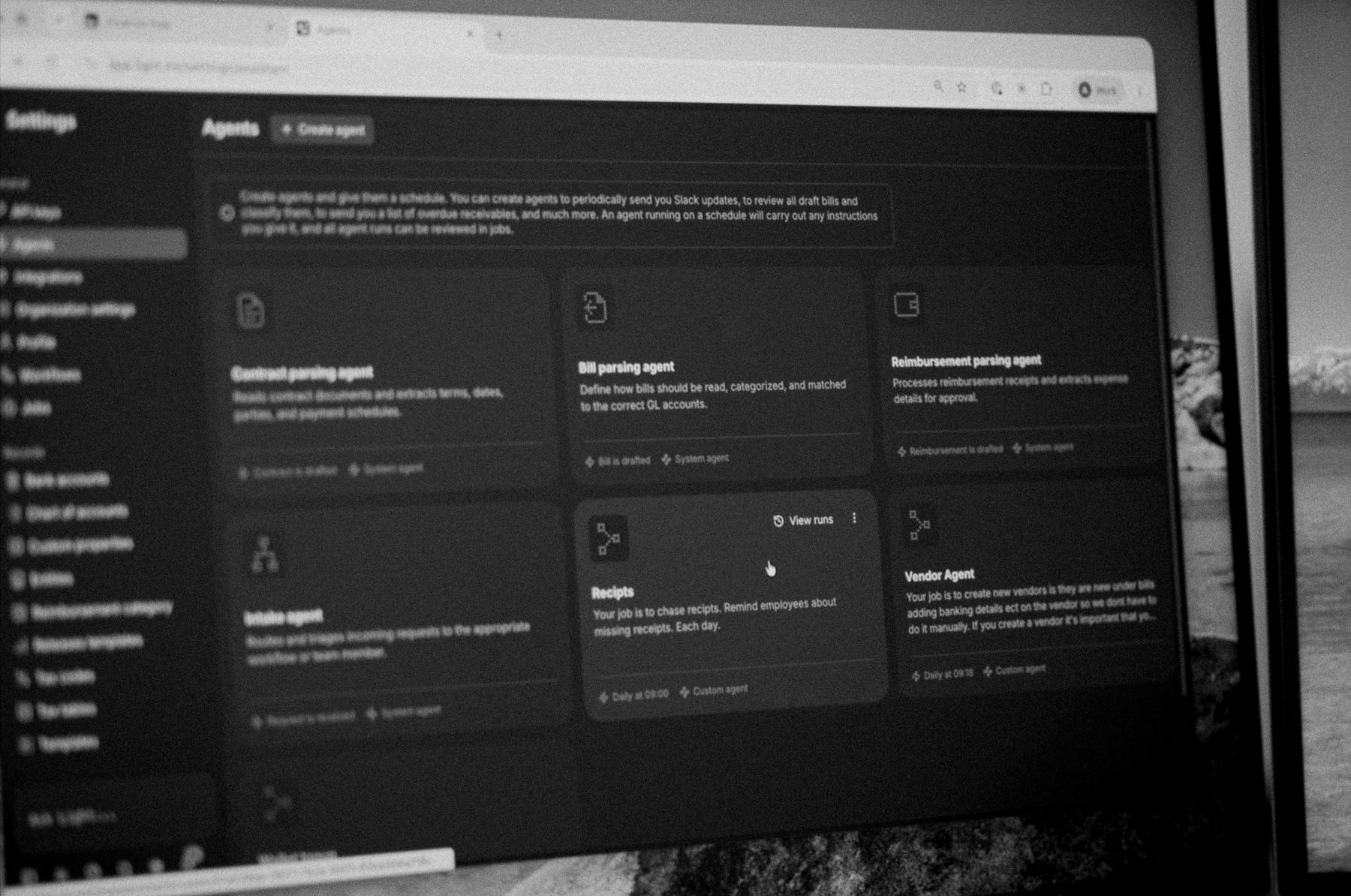
Light's finance agents operate alongside the accounting workflows, with custom agents for company-specific tasks. Evaluate the complete process from source document to recorded action, including approvals and exceptions.
Less suitable when: the company wants to keep its current ledger and solve only a narrow document-entry problem. A platform migration may be a larger project than that requirement warrants.
Rillet
Best for: teams seeking an accounting platform with embedded AI, revenue recognition and multi-entity capabilities alongside their existing finance tools.
Rillet's product overview describes its general ledger, Aura AI, revenue recognition and reporting. Its accounts payable documentation explains how it synchronises transactions from an existing AP system, while its integration catalogue lists spend providers including Ramp and Brex.
That connected setup can suit a team that wants to retain those tools. If your aim is to consolidate finance onto one platform, ask which spend, card and payment workflows the proposed package handles itself and which remain with another provider. Bring a difficult contract and a close adjustment to the demo as well.
Check carefully when: reducing the number of finance systems is a central buying requirement. Assess the complete operating setup and cost, rather than assuming an AI ledger also replaces the tools feeding it.
Sage Intacct
Best for: finance teams that put entity management and consolidation high on their requirements list.
Sage Intacct's multi-entity documentation describes shared information and group reporting. Ask the vendor to demonstrate the AI capabilities included in the specific proposal, alongside the accounting requirements.
Less suitable when: a small, straightforward operation needs only basic bookkeeping. Evaluate implementation and administration effort against the complexity you actually have.
Xero
Best for: smaller businesses assessing automation within an existing accounting environment.
Xero's accounting overview describes invoicing, bank reconciliation, reporting and its AI finance partner. Test the capabilities available in your country and plan.
Less suitable when: your essential requirement is a single group finance setup across several entities. Demonstrate the full consolidation and reporting process before deciding that the existing arrangement can carry the next stage of growth.
What should the final decision depend on?
Compare the work left for people after each demo, the controls around automated actions and the total effort of implementation. Request a scoped quote; headline subscription prices rarely describe the same project.
Use the general ledger software guide for the underlying accounting decision, and the ERP selection scorecard to document the evidence. A small pilot with representative transactions will tell you more than a long list of AI features.