
CustomersB2B marketing attribution and activationDreamdata
Dreamdata built the finance team they think is coming. It runs on Light.
Month-end close
20 Days → 1
Closing took 20 days on e-conomic. Now it takes one. Zero is next.
Outsourced bookkeeping
1.5 FTE → 0
Agents now handle coding, VAT, transaction splits and deferred schedules.
Consolidation
3 ledgers → 1
Three general ledgers in e-conomic became one centralised platform.
Dreamdata is the agentic marketing platform for B2B marketers. It brings ads, website visits, emails and CRM data into one timeline, showing revenue teams what actually creates pipeline, and helping them act on it.
Dreamdata's finance team has a pretty clear view of where their industry is going. AI won't just make finance teams faster, it will change what those teams look like. So they started building that future themselves.
Founded in Copenhagen in 2018, Dreamdata now operates across Copenhagen and New York, with roughly half its revenue coming from North America. The company raised a $55M Series B in October 2025, led by PeakSpan Capital, while ARR more than doubled, and finance stayed at three people.
CFO/COO Peter Egehoved leads finance alongside HR, RevOps, legal and compliance. Andreas Jørgensen joined as Senior Controller in February and owns bookkeeping and controlling, and Lívia Hanisch owns revenue. Before joining Dreamdata, Peter spent ten years as an investor, sat on the boards of around 30 B2B companies, and worked as an ERP consultant, so he had seen enough finance teams and enough finance software to have a strong opinion about what should come next.
- Customer
- Dreamdata
- Industry
- B2B marketing attribution and activation
- Entities
- 3 on Light: Danish operating company, US operating company, Danish holding company
- Website
- dreamdata.io
01The Challenge
The old stack wasn't built for the finance team they wanted
Before Light, Dreamdata ran three separate general ledgers in e-conomic. Each entity had its own setup, and consolidation happened manually every month.
The charts of accounts overlapped in some places and diverged in others, so closing meant moving data between systems and spreadsheets.
The bigger problem was the gap between finance and the rest of the business. Sales would sign a contract, HubSpot would show the ARR, then finance would open another system and recreate the transaction, right down to manually typing the customer's name and address.
Things were super disjointed. We would take some of that data and manually create an invoice, typing in even the address of the customer, then send it and hope they would pay.
Peter has a simple test for whether a finance stack actually works: can it build a deferred revenue schedule from the commercial data? Dreamdata's couldn't. Commercial reporting and financial reporting lived in different worlds. HubSpot could show the ARR, but finance still had to reconstruct the underlying transaction. And for a team that wanted agents to do more of the work, disconnected systems weren't just inefficient. They were a dead end.
02The Solution
They weren't looking for another ERP
Dreamdata went to market looking for the finance systems being rebuilt around AI. Peter wasn't trying to shave a few hours off bookkeeping, he wanted infrastructure his team could build on. For him the direction was obvious. The question was whether to move now or wait. They moved.
The migration ran through Sunrise, Light's migration platform. Dreamdata brought across its opening balances from 31 December 2025 and every transaction from 2026, line by line. Peter didn't want January living in one system and July in another, especially in an audited year while the company was raising.
You take whatever old general ledger data we have, convert it to a new chart of accounts with dimensions and cost centres and entities, and press live. It is an automated process these days. I have not seen another vendor able to do that.
All three entities went live on 1 April 2026. Entities, departments and cost centres now live as dimensions on the transaction itself, instead of being buried inside account codes. But Dreamdata wasn't waiting for the migration to finish before it started building.
03The Story
Before they built on Light, they built alongside it
When Andreas joined, he set out to automate as much repetitive finance work as possible. Six weeks before Dreamdata went live on Light, while the migration was still running, he started building against the API. Using Claude, he built what became Dreamdata's Finance Hub.
It reconciles every account in the ledger. It runs deferred revenue waterfalls. It tracks payroll liabilities and receivables. It accrues expenses that haven't cleared approval by month end. And it doesn't blindly accept what's in the ledger: it reads the underlying data and applies Dreamdata's own accounting logic. When Light coded a Microsoft charge as software, for example, the Finance Hub read the receipt and moved it to paid advertising.
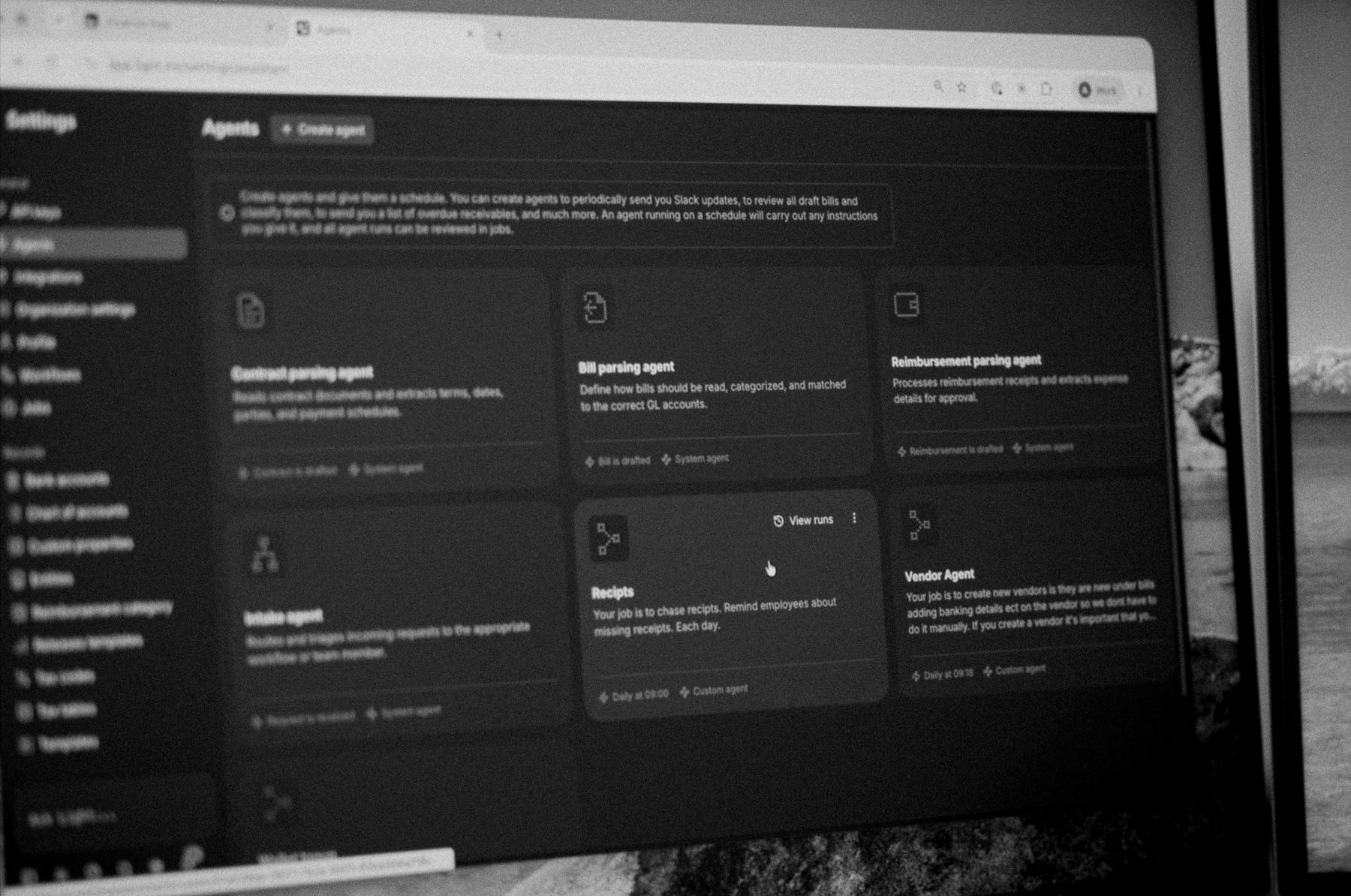
Then they kept building. A bill agent reviews coded transactions, fixes anything it disagrees with, adds deferred schedules, splits transactions when VAT treatment differs, and confirms the result back in Light. A receipt agent chases missing receipts through Slack. Peter built a Mercury bank integration on Light's API in an evening, then asked Light to take it over. The result is a ledger that's already been reviewed before month end starts.

Instead of having 8 people in finance, I can have a couple of hundred agents and a few key people.
That line gets to the heart of how Dreamdata thinks about finance. The aim isn't to put AI on top of the same old processes, it's to decide which work needs a person, then build agents for the rest. Light gives them the financial infrastructure underneath it. Dreamdata supplies the logic that's specific to Dreamdata.
Now they're building on top
Dreamdata initially built many of its agents adjacent to Light, using Light's API and data as the foundation. The next step is bringing more of that work into the platform itself.
Peter made the case to our product team in July. Light has to build for thousands of companies, Dreamdata only has to build for Dreamdata. That means its team can spend more compute, more context and more tokens solving a very specific finance task, because the alternative isn't cheaper software, it's another hire.
It's also the direction we were already taking Light. Custom Agents landed in Dreamdata's account in August, giving the team a way to bring more of the workflows it prototyped outside Light directly into the platform, while keeping Dreamdata-specific business logic where it belongs.
This is the exact direction we were hoping you would take. In finance there is a lot of repetitive work, it is ripe for automation, and it is so difficult to do if your general ledger does not want you to do it. We feel more confident with your systems running these agents than ours.
The App Store follows the same pattern. Dreamdata needed a Zenegy payroll integration, so it built one itself, which proved the use case. Light then built the production Zenegy app for the App Store. It's live today and installs directly in Light, so Dreamdata no longer needs to maintain its own version. Dreamdata builds the thing it needs, Light learns from it, and the best ideas can become infrastructure for everyone.
Built with them, not just for them
Dreamdata's Copenhagen office is ten minutes from ours, and that proximity has turned into a pretty direct product loop. Kyle and the product team have run workshops with Peter and Andreas in their office, and Andreas has spent hours stack-ranking card feedback with the team. Features have gone from conversation to product in weeks.
The cash balances endpoint exists because Peter asked for it. The AR aging view came out of the same sessions, replacing analysis Dreamdata used to assemble manually.
The relationship goes both ways. Dreamdata builds things on Light that we learn from, and our product team uses those workflows as input for how Light's own AI layer should work. They're not waiting for us to tell them what AI in finance looks like. They're building their version of it, and pushing us to build faster too.
Finance lives in Slack
For most of Dreamdata, finance doesn't happen in a finance system. It happens in Slack. Managers approve bills there, often within minutes. Light pulls receipts from the inbox, and if one is missing, the cardholder gets asked for exactly what finance needs, in the place they're already working. Agents post their results there too.

The entire team is happy with the Slack integration. We are not chasing people anymore.
And finance data is no longer just for finance. Customer success can check whether a customer has paid without asking finance or opening another system. It's what becomes possible when the whole company works from one modern agentic platform.
What Dreamdata runs on Light
- Three entities, consolidated from day one.
- A one-day month-end close, down from 20.
- Agents handling bill coding, VAT, transaction splits, deferred schedules and receipt collection.
- Dreamdata's Finance Hub, built on Light's API, reconciling every account in the ledger.
- AR and invoicing workflows connecting commercial data to finance.
- Bill approvals, reimbursements and receipt requests through Slack.
- Payments to Jyske Bank over a host-to-host connection.
- App Store integrations, including the live Zenegy payroll app.
- Full 2026 transaction history migrated through Sunrise across 13 bank accounts and four currencies.
04The Result
Three people, backed by agents
Dreamdata's finance team is still three people. They're running three entities across two continents, while ARR has more than doubled. Peter estimates the same operation would need eight people without Light.
The outsourced bookkeeping work that once amounted to 1.5 FTE is gone, agents handle it instead, and month-end has fallen from 20 days to one.
But the bigger change is what those three people spend their time doing. With clean, structured data underneath them, finance can answer questions that used to get buried under bookkeeping: where should Dreamdata invest, should it open an office in a new region, how aggressively can it hire, did the last sales cohort ramp well enough to justify the next one. The repetitive work moves to agents. The judgement stays with the team.
That's the finance function Peter and Andreas set out to build. First they built around the limitations of their software, then they built alongside Light. Now they're increasingly building on top of it. And Peter doesn't see that shift as optional.

Either you are implementing this or you are getting replaced by someone who is. There are still things that need your judgement as a CFO. Collecting receipts is not one of them.
Build the finance team you actually want
Dreamdata didn't wait for the future of finance to arrive. They started building it. Light gives that team one ledger, one source of truth, and a platform their agents can run on.
Book a demoMore customer stories
-

All Gravy builds the employee app that frontline teams actually open. Communications, onboarding, training, compliance, and daily operations, in one branded app for the people running the floor.
Read the story -
Alva Labs
Alva Labs builds an AI-native hiring system so companies decide on evidence, not gut feel. Their finance team wanted to run the same way.
Read the story -

At Light, we believe finance should be everyone's tool, not just the finance team's.
Read the story -

KeyShot builds the 3D rendering software behind how the world’s products are brought to market. Its finance team runs deliberately lean.
Read the story -
Ocean.io
Ocean.io is a global B2B data and go-to-market intelligence platform, used by sales and marketing teams to identify, target, and win the right customers, across Denmark and the US.
Read the story -

Officeguru is now live on Light, having gone from first call to signed contract in just 7 days.
Read the story -

Omnea is the agentic operating system for procurement, helping businesses control spend and risk while staying agile.
Read the story -

Omnio Group runs the payments, loyalty, and rewards infrastructure behind some of the world’s biggest enterprise brands.
Read the story -

Perlego has chosen Light to bring royalties, revenue and finance across its UK and US entities onto one platform, replacing Xero, spreadsheets and a patchwork of point tools.
Read the story -

Oper Credits builds AI-driven software that automates mortgage processing for financial institutions across Europe, running three legal entities across Belgium, Switzerland, and the UK.
Read the story -

Paebbl has moved its group finance operations onto Light, replacing three separate ERP systems with one global platform.
Read the story -

Tillo is the infrastructure behind gifting and rewards: a B2B marketplace connecting brands with partners in 23 countries, through 4 trading entities.
Read the story