

Month-end close
Nearly 4 weeks → 5 days
A five-day close was deepset’s first target on Light, and it has hit it every month since go-live.
Card and reimbursement bookkeeping
2 days → 2 to 3 hours
A weekly AI workflow codes every card transaction and reimbursement, and a person approves each posting.
Outsourced bookkeepers
2 → 0
A finance team of two runs both entities. The tax advisor now handles the German annual filing and nothing else.
deepset ran two entities on outsourced ledgers it could not open, and month-end took nearly four weeks. On Light, a team of two closes in five days.
deepset helps companies build AI agents and applications on Haystack, its open source framework, and gives them a platform to build, operate and govern those applications. The company employs 80 people across two entities, with headquarters in Berlin and offices in Barcelona, London and New York. Alex Simpson joined as VP Finance & Commercial Ops in December 2024 and runs every part of finance operations with Maren, the team’s finance manager in Germany.
- Company
- deepset
- Industry
- AI agent and application platform
- Entities
- 2 entities across Germany and the US
- Website
- deepset.ai

01The Challenge
The challenge: two ledgers deepset could not open
When Alex joined, each entity ran its own finance setup. Local bookkeepers kept the books in DATEV for Germany and QuickBooks for the US, and one tax advisory firm served both entities, yet its two teams never spoke to each other. deepset had no direct login to either ledger, so every number, every answer and every improvement depended on what the outsourced team could deliver.
The main pain point was not having direct access to our own financial numbers. As a finance leader, that creates a lot of challenges: delays in getting numbers, no full visibility, and a long wait every time we had a question.
Around the ledgers sat a second set of duplicates. Spendesk ran expenses and AP in Europe, Ramp did the same job in the US, Lexoffice handled AR invoicing, and each entity banked with its own institutions, so two entities meant two versions of the same stack.
Month-end took nearly four weeks. For a company that builds AI agents for a living, that pace no longer fit the business it served.
02The Solution
The solution: one ledger, live in two hard stops
Alex knew Light before deepset needed it. At a previous company, Alex worked with Peter, one of Light’s founding designers, and followed what the team built, but that business wasn’t ready for a switch. deepset’s setup made the case from the first week, so when a cold email from Light arrived, Alex replied.
Three things decided it: one platform across both entities, AP, AR and payments in the same system as the ledger, and the chance to bring finance in house and cut the reliance on external tax advisors.
A big advantage with Light is that we consolidated our tech stack for AP, AR and payments into one. That’s five tools down to one.
deepset’s finance stack
deepset’s finance stack before Light: DATEV and QuickBooks as two outsourced ledgers, Spendesk and Ramp for expenses and AP, and Lexoffice for AR invoicing. deepset’s finance stack with Light: one ledger for both entities, Salesforce contracts flowing into Light, and DATEV kept for the year-end filing.
Two launches, no overlap
The team signed in August 2025, which makes deepset one of Light’s earliest customers. They launched the US first, the smaller entity with fewer customers and employees, and went live in under two months with a hard stop on QuickBooks. Germany followed in January 2026 with a hard stop on DATEV, so the old and new systems never ran side by side.
A shared Slack channel kept both teams in regular contact through implementation. When deepset flagged something missing, or a setup it didn’t understand, Light turned it around fast.
A German company that can grow beyond Germany
DATEV dominates German accounting, but it has no natural partner tool in the other markets a growing company enters. Every new entity meant new data formats to stitch together and maintain. On Light, deepset runs every entity in one ledger, then exports a DATEV file at year-end so its tax advisor can handle the annual filing, which is now the only point in the year the advisor touches the accounts.
If I need to create an entity in Spain tomorrow, I know what the setup will look like and I know it will be quick. Before, that would have taken a lot more time.
03The Story
The story: from outsourced books to a finance brain
With the ledger in house, Alex and Maren started building. Early in 2026, as new Claude models made finance automation a live topic, they wrote Google Apps Scripts that pulled data from Light’s API into Google Sheets to refresh cash flow forecasts and reports.
Bookkeeping that runs every week
That first step grew into a full bookkeeping workflow. Once a week it reads every new card transaction and reimbursement in Light and assigns the account and cost centre with fixed rules, the way any bookkeeping process works. When the rules can’t decide, an AI layer reads the description and the invoice, recommends a posting and sends it back to Light, where Maren checks and approves it.
Card transactions and reimbursements took around two days at month-end. Now that’s down to two or three hours.
A context layer the workflows can read
The workflow works because the data underneath it holds up. deepset set up its cost centres in Light and linked them to its HR tool, wrote a description for every account, and loaded its expense and travel policies. Light’s own agents use that context to run the first checks on reimbursements, and deepset’s external workflows use the same context through the API.
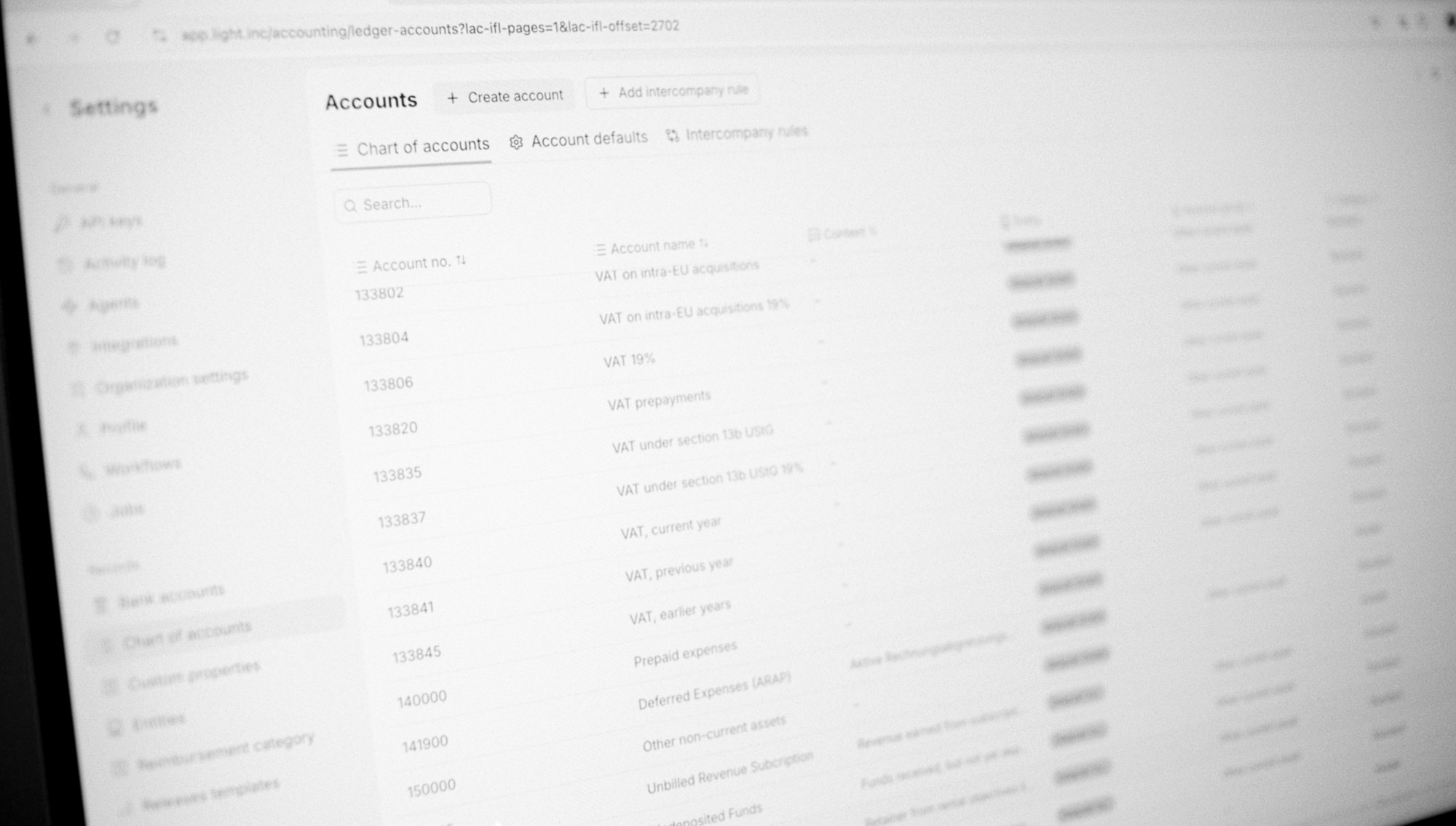
Building out the context layer within Light helps a lot. We can build workflows on top, and they understand our brain and how we want to operate.
Finance stops playing the bad cop
Employees get 24 hours to upload a receipt. After that, an automatic Slack message asks for it, and the employee uploads it through Light’s Slack connection or snaps it on the mobile app, where OCR reads and categorises it. deepset also moved expenses and AP from Spendesk and Ramp into Light, and the team expected pushback that never came, because the new flow felt familiar.
In finance we don’t always want to be the bad cop, even though we have to be. If technology can play that role, we keep the human-to-human relationships better.
Apps for local rules
Two countries mean two sets of travel rules. deepset runs the Per Diem and Mileage apps from the Light App Store, so every expense claim uses the right local rate without a custom build. The team is now looking at the German Audit Export app for tax audits, and the Remote and Personio apps to bring people data into the ledger.
Analysis that arrives with the numbers
For software spend, a workflow calculates the variance against thresholds deepset sets itself. Anything inside the threshold passes with no comment, and anything outside it triggers an AI review of the invoices in Light, which explains the jump, such as ten extra seats on one tool. The team spends its time on the decision the analysis points to.
Revenue from Salesforce to forecast
deepset sells to enterprise and public sector customers, so its revenue carries nuances, including services it can only recognise on delivery. A signed contract flows from Salesforce into Light, which creates the invoice and builds the deferred revenue schedule. The team reconciles that against ARR, tracks professional services each month with its customer engineers, and layers renewals, late-stage deals and draft invoices in Light on top to produce one revenue forecast.

People still post every entry
The controls stay where they were. No AI posts to Light, a person approves every entry, and the monthly balance sheet and cash reconciliations catch anything that goes wrong. deepset builds one workflow at a time, so nothing turns into a black box.
A finance brain in GitHub
Alex and Maren each built workflows in Claude Code, and at a team offsite they found the problem: neither could reach the other’s work. They now keep a shared repo in GitHub that holds every finance skill and agent in one structure, mirrors the context in Light, and adds context from the CRM, HR and product data. Month-end has become a list of tasks, and the team goes through it one task at a time, asking which ones AI can take.
Alex had never touched GitHub until two months before this interview. What sold the repo was the audit trail and the versioning, and the test it sets for the team: if anyone left, a replacement could read the repo and run finance within a week.
You want your core central tool, like Light, as your system of record. Don’t touch that, it’s working. Then we build our own tools on top for our workflows, and if we need to change something, we do it ourselves.
What deepset runs on Light
- One ledger for the German and US entities, replacing DATEV and QuickBooks.
- AP, AR and payments for both entities in one platform, replacing Spendesk, Ramp and Lexoffice.
- A weekly bookkeeping workflow on Light’s API that codes card transactions and reimbursements, with a person approving every posting.
- Light agents that run first checks on reimbursements against deepset’s expense and travel policies.
- Receipt reminders and uploads through Slack and the Light mobile app.
- Salesforce contracts that flow into Light invoices and deferred revenue schedules, also replacing an external AR tool previously used.
- Software spend variance analysis, with AI commentary on anything outside threshold.
- A year-end DATEV export for the German tax filing.
- The Per Diem and Mileage apps for country-specific travel allowances.
04The Result
The result: a five-day close with a team of two
deepset set a five-day close as its first target on Light and has hit it every month since go-live, down from nearly four weeks. Two people run finance across both entities with no outsourced bookkeepers, and the tax advisor now handles the German annual filing and nothing else.
Card and reimbursement bookkeeping dropped from around two days a month to two or three hours, and missing receipts no longer hold up month-end. The setup scales with the business too: if transaction volume doubles next year, the workflows absorb it without a new hire.
Tasks that used to go back and forth for days now run themselves. We come in for the approval or the review, so we work in a smoother process and a much less pressurised environment.
If we double the number of transactions we process next year, we know the current setup will work. It won’t be a case of ‘now we need to hire someone’.
Where deepset’s finance team is heading
The next target is a close of two to three days in 2027, and Alex sees a path to one. After the close comes forecasting that updates in real time, built on more connected data sources, so finance can sit inside the decisions on hiring, new markets and big enterprise deals. The finance brain in GitHub will also meet a company-wide effort at deepset to build a shared context layer, so every team reads the same definitions, starting with what “revenue” means.
I wouldn’t be surprised to see a team doing $100 million plus in ARR with three or four people. Each person can 10x what they do based on the tooling running in the background.
For finance leaders who feel cautious about AI, Alex’s advice is to start with the task that eats the most team time, run a small experiment beside the current process, and write down how finance works along the way.

Start small and find your biggest pain point. Once you get comfortable, you can start accelerating.
Run finance on evidence, not effort
See what Light could do for your company. Book a demo with our team.
Book a demoMore customer stories
-

AppTweak ran finance on an ERP chosen for its majority shareholder, a media group. Bank reconciliation was manual, vendor risk lived in a spreadsheet, and every new supplier was entered twice. On Light, agents reconcile the banks, the close takes half the time, and the CFO built his first agent in a couple of hours.
Read the story -

All Gravy builds the employee app that frontline teams actually open. Communications, onboarding, training, compliance, and daily operations, in one branded app for the people running the floor.
Read the story -
Alva Labs
Alva Labs builds an AI-native hiring system so companies decide on evidence, not gut feel. Their finance team wanted to run the same way.
Read the story -
Dreamdata is the agentic marketing platform for B2B marketers. It brings ads, website visits, emails and CRM data into one timeline, showing revenue teams what actually creates pipeline, and helping them act on it.
Read the story -

At Light, we believe finance should be everyone's tool, not just the finance team's.
Read the story -

KeyShot builds the 3D rendering software behind how the world’s products are brought to market. Its finance team runs deliberately lean.
Read the story -
Ocean.io
Ocean.io is a global B2B data and go-to-market intelligence platform, used by sales and marketing teams to identify, target, and win the right customers, across Denmark and the US.
Read the story -

Officeguru is now live on Light, having gone from first call to signed contract in just 7 days.
Read the story -

Omnea is the agentic operating system for procurement, helping businesses control spend and risk while staying agile.
Read the story -

Omnio Group runs the payments, loyalty, and rewards infrastructure behind some of the world’s biggest enterprise brands.
Read the story -

Perlego has chosen Light to bring royalties, revenue and finance across its UK and US entities onto one platform, replacing Xero, spreadsheets and a patchwork of point tools.
Read the story -

For Oper's finance manager, month-end used to mean chasing receipts, consolidating spreadsheets and waiting weeks for the numbers. Now, AI agents do the legwork, and the books close in days.
Read the story -

Paebbl has moved its group finance operations onto Light, replacing three separate ERP systems with one global platform.
Read the story -

Tillo is the infrastructure behind gifting and rewards: a B2B marketplace connecting brands with partners in 23 countries, through 4 trading entities.
Read the story