Ocean got Light, cut month-end close by 60%

Ocean.io is a global B2B data and go-to-market intelligence platform. Sales and marketing teams use it to identify and target the right accounts, based on a lookalike logic that surfaces companies and contacts similar to the ones already working.
With operations across Denmark and the US, Ocean.io serves everyone from early-stage startups to enterprise GTM teams. Kristoffer's job is to make sure the finance function supports that growth without becoming a drag.
Kristoffer Kania Nygaard · CFO, Ocean.io
The problem: different tools, different rules, wrong numbers.
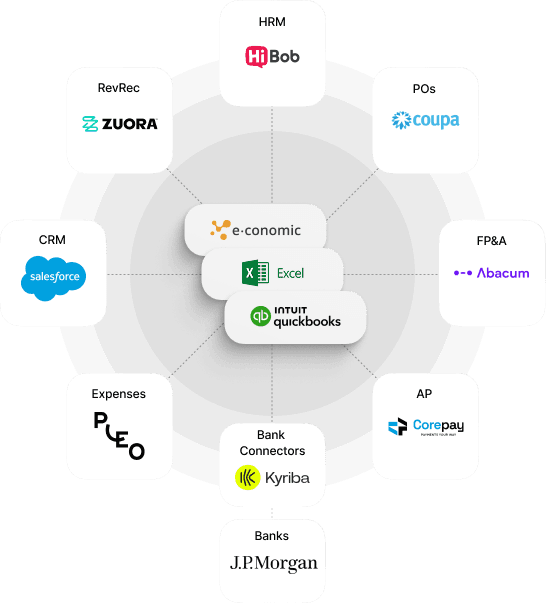
When Kristoffer joined, Ocean.io ran QuickBooks in the US and E-conomic in Denmark. The two entities didn't even share the same chart of accounts. Pleo handled expenses. Corepay handled something else. The US entity had a separate CPA producing its own reports.
The result was a consolidation process that never really worked. Christopher knew the numbers weren't accurate, and getting a clear picture of how much Ocean spent by department required manual effort that shouldn't have been necessary for a company of this size.
Kristoffer Kania Nygaard · CFO, Ocean.io
Finding Light
Built for consolidation from day one.
Kristoffer's criteria were clear: a consolidated view across entities, AI that could reduce the manual work, and a team that would actually respond when something wasn't working.
He wasn't interested in tools built for large, complex organisations. Ocean doesn't need that. It needs a financial engine that keeps things right while the commercial side of the business moves fast.
The consolidation capability was what made the decision easy. Everything else could be worked around.
A product that had multi-entity consolidation built in from the start was, as Kristoffer puts it, a no-brainer.
Kristoffer Kania Nygaard · CFO, Ocean.io
Multi-entity consolidation
Before Light, consolidating across Denmark and the US meant working across two different accounting systems with two different charts of accounts. Now it happens inside a single platform. Kristoffer describes it as the number one thing he likes about Light: the ability to consolidate fast and without friction.
The shift isn't just operational. Before, Kristoffer couldn't trust the numbers he was looking at. Now he can. That changes what the finance function is actually capable of.
Kristoffer Kania Nygaard · CFO, Ocean.io

AP automation and bill splitting
Kristoffer's day-to-day in Light is mostly the AP flow. When a bill arrives in the inbox attached to Ocean's Light account, the AI assistant codes it to the right P&L accounts based on rules Christopher has set up in advance. If it's a recurring vendor, he checks the accounts and hits approve. That's it.
For new vendors, Light pulls the information automatically and adds them to the flow with one click. The ability to split a bill across the right P&L accounts from the moment it comes in, without manual intervention, is what Kristoffer calls one of Light's strongest features.

Kristoffer Kania Nygaard · CFO, Ocean.io
The future of finance? Less admin. More commercial spirit.
Kristoffer's view of the finance function is direct: it's there to help drive the business, not to make sure numbers are right and report them to someone. Light has made the second part largely automatic, which means he can spend more time on the commercial and product side of Ocean's work.
His vision for where Light goes next is an automated controlling layer. A business like Ocean's should be runnable by just him and Light. He doesn't see why it would require more people, and Light's direction toward agents reinforces that.
Compared to last year, when Ocean had a separate CPA team for the US entity and a separate team for Denmark, it's now Kristoffer, one part-time person, and Light.
See Light in action
Ready to cut 80% of manual work? Let’s chat about how Light can hand the heavy lifting to AI so your team can focus on what matters.