Intercompany accounting software helps a group record, reconcile and report transactions between its own legal entities. The process may include reciprocal entries, balance matching and eliminations in consolidated accounts.
The two sides of a transaction need a shared reference and a clear explanation, but they can still require different local accounting treatment. Bringing the records together helps the team investigate differences; it does not make every difference an error.
Where do intercompany differences come from?
A recharge can reach one entity before another. The teams may use different posting dates, currencies or account mappings. A credit note may update only one side, or a payment may settle several balances at once.
Start by classifying the differences in the last close. Timing, foreign exchange, missing documents and disputed amounts need different responses. A single suspense account can hide those causes instead of resolving them.
Give each intercompany relationship an owner and a route for agreeing corrections. The software should support that process with the source records visible to the people who need them.
What should a transaction record contain?
Use an entity and counterparty identifier, a shared reference, the relevant dates, currency and amount, and supporting documentation. Keep the purpose of the charge clear enough for the receiving entity to review.
For recurring allocations, document the basis and approval. If the allocation changes, the team needs to know which period the new method applies to and how it affects both sides.
Software can apply an approved allocation rule. Finance still owns the accounting policy, and specialist advice may be needed for the tax or transfer-pricing treatment. Do not use a matching result as evidence that those separate requirements are satisfied.
How are reconciliation and elimination different?
Reconciliation explains whether reciprocal records agree and resolves the differences. Elimination adjusts the consolidated accounts so the group does not report internal activity as though it involved an outside party.
The underlying entities still retain their own records. A consolidation adjustment should therefore remain distinguishable from an entry in a subsidiary's statutory books.
Use the financial consolidation guide to test that distinction. For foreign currency balances, include the rate and reporting questions in the multi-currency accounting guide.
What does an intercompany elimination look like?
Consider an illustrative €10,000 service charge between two wholly owned subsidiaries, A and B. Both use euros, record the charge in the same period and remain in the consolidation throughout that period. B has consumed the service and has not paid A. The example excludes VAT, other taxes and foreign exchange.
Each entity records its side of the charge:
| Entity | Debit | Credit |
|---|---|---|
| A, providing the service | Intercompany receivable €10,000 | Service income €10,000 |
| B, receiving the service | Service expense €10,000 | Intercompany payable €10,000 |
A records income and an amount due from B. B records an expense and an amount due to A. Before consolidation, finance matches the entity pair, shared reference, period and amount. If B has recorded only €9,000, the team must investigate the €1,000 difference and correct the appropriate source record before treating the pair as reconciled.
With both sides agreed at €10,000, the group makes two elimination adjustments:
| Adjustment | Debit | Credit |
|---|---|---|
| Remove the internal income and expense | Service income €10,000 | Service expense €10,000 |
| Remove the internal balance | Intercompany payable €10,000 | Intercompany receivable €10,000 |
The consolidated accounts now show zero income, expense, receivable and payable from this internal charge. Both entities keep their original entries. Any costs A incurred with external suppliers remain in the group accounts. The elimination removes the internal income and expense equally, so it does not create extra group profit.
This illustrates the intragroup elimination principle in IFRS 10. Asset transfers, unrealised profit, foreign currencies and different ownership arrangements need additional accounting analysis.
Which cases belong in the demonstration?
Give the vendor a recharge with one side posted late, a foreign currency balance and a partial settlement. Ask it to show the open difference, assign an owner and preserve the explanation after resolution.
Next, produce the group report and inspect the elimination. Correct the source transaction and check what changes. Finance should be able to follow the original records, the correction and the group adjustment without reconstructing the sequence in a spreadsheet.
How does Light approach intercompany work?
Light's consolidation software keeps entity postings and group eliminations traceable. Use the service charge above to test the documented intercompany journal workflow:
- Configure the intercompany account rules and which source lines require elimination.
- Create an intercompany journal with the source and receiving entities, accounts, dates, currency and amounts. Review the elimination setting on each line.
- Check the Net impact preview by entity and account before posting, then inspect the resulting postings and activity history.
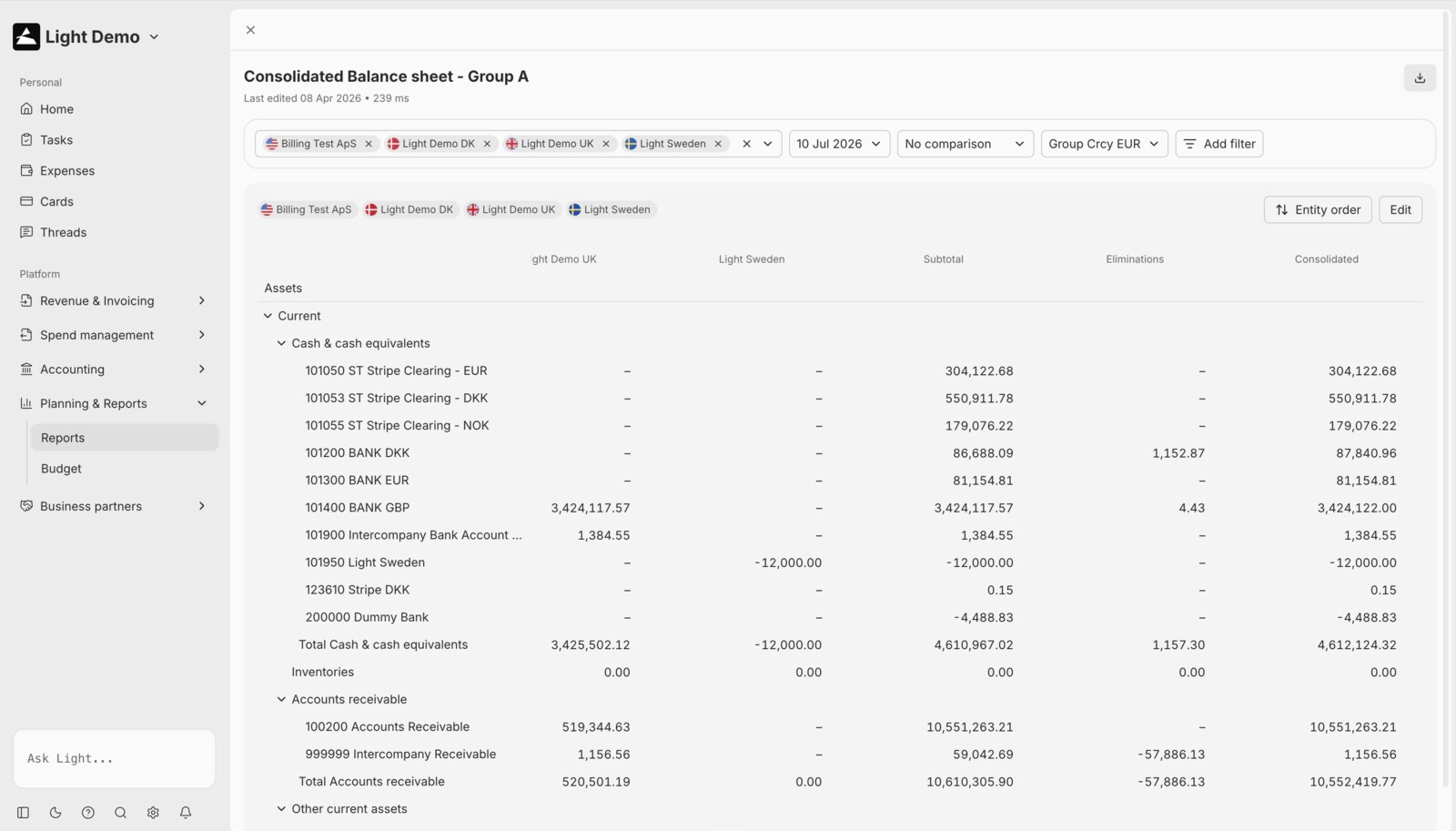
- Open a consolidated report for the same entities and period. Compare the entity columns with the subtotal, eliminations and consolidated result, then drill into the elimination to inspect its source.
The intercompany documents guide explains the configuration and entry fields. The consolidated reporting guide explains the report columns and drilldown. Confirm the generated postings against the example rather than entering a second copy of offsets the system has already created.
Alva Labs' customer story describes consolidation and intercompany elimination across its Swedish, Norwegian and UK entities in Light. It provides a real operating context for the workflow; the €10,000 example above is illustrative and does not describe an Alva Labs transaction.
Evaluate that benefit against your actual recharge, settlement and reporting processes. If some subsidiaries remain on other systems, include their data arrival and reconciliation in the demonstration.
Track unresolved balances by age, the number of manual corrections and the time spent explaining differences. The multi-entity accounting guide helps place those requirements within the wider platform decision.